
Chelsea 'Old Church': A worked example
Source:vignettes/articles/worked_example.Rmd
worked_example.RmdThe churchyard of All Saints, Chelsea’s Old Church
Introduction
For the worked example to show the complete range of functions
provided by baytaAAR, we chose the churchyard of All
Saints, Chelsea’s Old Church (Cowie et al.
2008). For an overview of the site and the osteological
investigations, see the respective website of the Museum
of London.
The data of the osteological team of the Museum of London is freely available, including the age estimations and especially the raw scores that formed the basis for the finally published age ranges. If possible, the team applies four established age estimation methods to the human remains: Dental wear with Codes 1-4, Pubic symphysis with Phases I-VI, Auricular surface with Phases 1-8, and Costochondral with Phases 0-8. For the background of these methods and their application, see again the respective website of the Museum of London. From the complete Chelsea dataset, we chose those individuals where at least one of the four methods was applicable. As a special feature of this churchyard, for some of these individuals the age-at-death is known thanks to plates on the coffins.
This worked example proceeds in five steps: (1) data preparation, (2) single-trait models, (3) multivariate models, (4) model comparison and calibration, and (5) evaluation against known ages. One of the main aims is to sketch the process to arrive at plausible age estimates in terms of highest density intervals when the data set contains a lot of missing instances. The complete-case model best captures joint trait covariance without imputation, hence provides the least biased estimate of the underlying uncertainty structure.
Loading data
The first step is the loading and preparation of the data. For that,
we download and extract the data directly from the website of the Museum
of London and extract it. The second table contains known age-at-death
for some of the individuals from plates on the coffins. We then filter
only the adults and expand the age estimation table. The two tables are
merged and only the CONTEXT column with the individual
number, the sex and age estimation as well as the raw age estimations
code and the known age-at-death column are retained. Finally, all
entries 9, which for all four age estimations methods equal
undecided, are converted to NA and only those
rows with at least one valid method are kept.
temp <- tempfile()
download.file(
  "https://dams.londonmuseum.org.uk/m/2dc89b01e62759ff/original/PMCOC.zip",
  temp, mode = "wb")
unzip(temp, "PMCOC_age_estimates.lst")
chelsea_age <- read.delim("PMCOC_age_estimates.lst",
                          sep = "|",
                          header = TRUE,
                          stringsAsFactors = FALSE,
                          row.names = NULL,
                          fill = TRUE,
                          strip.white = TRUE)

# absolute ages according to Cowie et al. 2008, 41 table 6
chelsea_known_age <- data.frame(
  CONTEXT = c(35, 147, 198, 462, 525, 622, 654, 681, 701, 713,
              722, 744, 792, 976, 980, 990, 1133),
  known_age = c(60, 67, 44, 61, 70, 84, 66, 84, 78, 68, 56, 70,
                68, 82, 54, 32, 70) )

chelsea_age_col <- colnames(chelsea_age)[-7]
chelsea_age <- chelsea_age[,-14]
colnames(chelsea_age) <- chelsea_age_col

chelsea_adults <-
  chelsea_age |> dplyr::filter(grepl("^(ADULT|UNCLASSIFIED ADULT)", AGE))

chelsea_adults_wide <- chelsea_adults |>
  dplyr::mutate(VALUE = as.numeric(VALUE)) |>
  tidyr::pivot_wider(
    id_cols = c(CEMETERY, SITECODE, PERIOD, LU_INT, E_DATE, L_DATE,
                CONTEXT, SEX, AGE, TRAIT_TYPE),
    names_from = EXPANSION,
    values_from = VALUE
  )

# combine both tables
chelsea <- merge(chelsea_adults_wide, chelsea_known_age,
                     by = "CONTEXT",
                     all.x = TRUE)

# limit data set to relevant columns
chelsea_mat <- chelsea[,c(1, 8, 9, 12,13,14,15,18)]

chelsea_mat[chelsea_mat == 9] <- NA
chelsea_complete <- chelsea_mat[rowSums(is.na(chelsea_mat[,4:7])) != 4, ]
chelsea_complete$AGE <- factor(chelsea_complete$AGE,
                               levels = c("ADULT 18-25 YEARS",
                                          "ADULT 26-35 YEARS",
                                          "ADULT 36-45 YEARS",
                                          "ADULT >46 YEARS",
                                          "UNCLASSIFIED ADULT"),
                               ordered = TRUE)
chelsea_complete$SEX <- factor(chelsea_complete$SEX,
                          levels = c("FEMALE",
                                     "FEMALE?",
                                     "INTERMEDIATE",
                                     "MALE?",
                                     "MALE"),
                          ordered = TRUE)

# define data sets with specific traits
chelsea_no_nas <- chelsea_complete[rowSums(is.na(
  chelsea_complete[,4:7])) == 0, ]
chelsea_ps_as <-
  chelsea_complete[rowSums(is.na(chelsea_complete[,5:6])) == 0, ]
chelsea_dental <- chelsea_complete[(!is.na(chelsea_complete[,4])), ]
chelsea_ps <- chelsea_complete[(!is.na(chelsea_complete[,5])), ]
chelsea_as <- chelsea_complete[(!is.na(chelsea_complete[,6])), ]
chelsea_costo <- chelsea_complete[(!is.na(chelsea_complete[,7])), ]

# show first lines, replace underscore with space for variable "known_age"
head(chelsea_complete) |>
knitr::kable (col.names = gsub("[_]", " ", names(chelsea_complete)))| CONTEXT | SEX | AGE | Dental wear (Codes 1-4) | Pubic symphysis Phases I-VI | Auricular surface Phases 1-8 | Costochondral Phases 0-8 | known age |
|---|---|---|---|---|---|---|---|
| 18 | FEMALE | ADULT 36-45 YEARS | 1 | 4 | 4 | 5 | NA |
| 19 | FEMALE | ADULT >46 YEARS | 3 | 5 | 8 | NA | NA |
| 20 | MALE | ADULT 36-45 YEARS | 3 | 5 | 4 | NA | NA |
| 31 | FEMALE | ADULT 36-45 YEARS | NA | 5 | 6 | 5 | NA |
| 35 | MALE | ADULT >46 YEARS | 1 | 5 | 6 | 6 | 60 |
| 39 | FEMALE | ADULT 36-45 YEARS | NA | 5 | 5 | 5 | NA |
The table above gives an impression of the data structure of the Chelsea individuals with estimated sex and age, the four traits used for estimations as well as a last column with known age-at-death for a few individuals.
Descriptive statistics
Next, we want to get an overview of the number of individuals, the sex estimations and especially the number of phases for each method.
chelsea_complete |> nrow()
#> [1] 152
All in all, there are at least 152 individuals with information on at least one method.
chelsea_complete[,2] |> table()
#>
#>       FEMALE      FEMALE? INTERMEDIATE        MALE?         MALE
#>           57           13            5           13           64
Based on the osteological sex estimations, it seems that both sexes are present in roughly equal numbers. The known-age structure is as follows:
chelsea_complete$known_age |> na.omit() |> as.numeric() |> sort()
#>  [1] 32 44 54 56 60 61 66 67 68 68 70 70 70 78 84 84
Most of the 16 individuals with known age-at-death are at least 60 years or above. There are only four individuals with a plate of younger age.
The following code produces an overview of the age estimations
methods and the counts per phase of each method, including the number of
NAs:
options(knitr.kable.NA = '')
chelsea_complete |>
  dplyr::select(starts_with("Dental"),
         starts_with("Pubic"),
         starts_with("Auricular"),
         starts_with("Costo")) |>
  tidyr::pivot_longer(everything(), names_to = "method", values_to = "phase") |>
  dplyr::mutate(phase = as.character(phase)) |>
  dplyr::count(method, phase) |>
  tidyr::pivot_wider(names_from = phase, values_from = n, values_fill = NA) |>
knitr::kable ()| method | 1 | 2 | 3 | 4 | 5 | 6 | 7 | 8 | NA |
|---|---|---|---|---|---|---|---|---|---|
| Auricular surface Phases 1-8 | 6 | 8 | 12 | 23 | 28 | 20 | 16 | 18 | 21 |
| Costochondral Phases 0-8 | 3 | 4 | 3 | 3 | 11 | 7 | 17 | 6 | 98 |
| Dental wear (Codes 1-4) | 27 | 15 | 6 | 16 | 88 | ||||
| Pubic symphysis Phases I-VI | 11 | 4 | 4 | 13 | 35 | 27 | 58 |
The overview shows that the costochondral is the method with the
least applicability (= most NAs) while the method with the
least NAs is the auricular surface, followed by the pubic
symphysis. Dental wear was possible to determine only in a few cases
more than the costochondral. All in all, the missing information is
considerable:
count_na <- sum(is.na(chelsea_complete[,4:7]))
count_cells <- nrow(chelsea_complete) * 4
round(count_na / count_cells * 100,1)
#> [1] 43.6
Overall, more than 40 percent of the cells are NA. This
level of missingness is expected to affect multivariate models via
imputation uncertainty.
Running baytaAAR
We will now analyse the Chelsea data with baytaAAR
systematically. This implies to analyse all methods separately and then
together. We will do the following runs, also indicate if we use the
JAGS or NIMBLE version as well as either
norm (multiple normal) or mnorm (multinormal)
in case of the inclusion of more than one method in the same run. The
difficulty here is that many entries, as shown above, are
NA. These will be a challenge for the multinormal analysis
as the unobserved nodes will have to be imputed. We will compare a
minimum set of individuals where all four methods are present with a
maximum set of the two most common methods, auricular surface and pubic
symphysis.
- only auricular surface (with
JAGS) - only costochondral (with
JAGS) - only dental wear (with
JAGS) - only pubic symphysis (with
JAGS) - all methods and only individuals with all methods present (with
NIMBLEandmnorm) - only auricular surface and pubic symphysis and only individuals with
both methods present (with
NIMBLEandmnorm) - all methods and all individuals (with
NIMBLEandmnorm) - all methods and all individuals with calibration term (with
JAGS)
Defining paths for downloading RDA-files
Please note that the models should run until the resulting Markov
Chain Monte Carlo (MCMC) samples meet certain quality criteria. As
already noted in the introductory article
(vignette("baytaAAR")), these are 10,000 for
ESS and below 1.1 for PSRF. To
spare the time in running the models, we saved RDA-files with the raw
MCMC-chains on Github for downloading and loading. If you
really want to run the models, set runNewMCMC to
TRUE. If not, stick to the negation !TRUE.
runNewMCMC = !TRUE
path <- "https://raw.githubusercontent.com/ISAAKiel/Chelsea_mcmc/main/"
Only single traits (with JAGS)
We first concentrate on only those individuals where the auricular
surface was assessable. The first argument method is the
trait which are used for age estimation, the auricular surface in this
case. The data has to be of the class matrix.
minimum_age and maximum_age truncate the
underlying Gompertz distribution to a reasonable range.
parameters denotes the estimated and monitored variables.
They have the following meaning:
- b: Gompertz beta
- a: Gompertz
,
in
bay.talinked deterministically to Gompertz to reduce volatility - beta0: the intercept of the latent continuous variable underlying the ordinal trait
- beta: the slope of the latent continuous variable underlying the ordinal trait
- thresh: the threshold value. The number of thresholds equals the number of levels of the trait minus 1
- age.s: the estimated age of each individual
The rest of the variables control JAGS.
multicore specifies here that the code is executed in
parallel for speed. thinSteps controls the amount of
thinning of the resulting Markov Chain. With 1 there is no
thinning. However, because the ordered probit model suffers from high
auto-correlation, this number will almost certainly not suffice. Setting
the number of numSavedSteps too high might lead to overly
large files. Therefore, it is always a good idea to start with a
moderate value for numSavedSteps of about
10,000 and a value for thinSteps of 1, and
then increase the number of steps according to the first result. A
future version of baytaAAR might also include the
possibility to define quality goals which the code should reach.
Finally, we run bay.ta with a seed for reproducibility
if ( runNewMCMC ) {
  chelsea_as_res <- bay.ta(
    framework = "JAGS",
    method = chelsea_as[,6],
    minimum_age = 18,
    maximum_age = 100,
    parameters = c( "b", "a", "beta0", "beta", "thresh", "age.s"),
    multicore = TRUE,
    thinSteps = 10000, # necessary 10000, takes 16 hours
    numSavedSteps = 80000,
    seed = 3901)
} else {
  file <- "chelsea_as_res.Rdata"
  temp <- tempfile()
  download.file(paste0(path, file), destfile = temp, mode = "wb")
  con <- gzfile(temp, "rb")
  load(con)
  close(con)
  threshold_as <- chelsea_as_res |> threshold.chains() |>
  diagnostic.summary() |> threshold.matrix(mean_choice = "Mode")
}
The resulting Markov chains are stored in the file
chelsea_as_res in the coda::mcmc.list() format
for further processing. The function diagnostic.summary()
provides a summary of the posterior estimates:
chelsea_as_diag <- diagnostic.summary(chelsea_as_res)
head(chelsea_as_diag[-c(9:12),], 20) |> knitr::kable (digits = 4)| PSRF Point est. | PSRF Upper C.I. | Mean | Median | Mode | ESS | MCSE | HDImass | HDIlow | HDIhigh | |
|---|---|---|---|---|---|---|---|---|---|---|
| M | 1.0000 | 1.0002 | 45.4775 | 47.4925 | 59.4297 | 70546.7 | 0.0773 | 0.95 | 6.1069 | 78.5853 |
| b | 1.0002 | 1.0006 | 0.0363 | 0.0323 | 0.0233 | 52284.1 | 0.0001 | 0.95 | 0.0200 | 0.0662 |
| a | 1.0000 | 1.0002 | 0.0128 | 0.0125 | 0.0075 | 70383.0 | 0.0000 | 0.95 | 0.0002 | 0.0254 |
| beta0 | 1.0003 | 1.0008 | -21.5060 | -21.3985 | -20.6710 | 15523.4 | 0.0535 | 0.95 | -34.7759 | -8.5747 |
| beta | 1.0003 | 1.0007 | 7.1481 | 7.1100 | 6.9539 | 14376.5 | 0.0178 | 0.95 | 3.0347 | 11.4485 |
| thresh[1,1] | 0.5000 | 0.5000 | 0.4997 | 0.0 | 0.95 | 0.5000 | 0.5000 | |||
| thresh[1,2] | 1.0002 | 1.0006 | 1.9635 | 1.8432 | 1.6870 | 31420.5 | 0.0037 | 0.95 | 0.9120 | 3.2764 |
| thresh[1,3] | 1.0001 | 1.0003 | 3.4145 | 3.2799 | 3.0093 | 20018.1 | 0.0073 | 0.95 | 1.5951 | 5.4751 |
| age.s[1] | 1.0000 | 1.0001 | 41.1489 | 38.4174 | 33.3702 | 58974.5 | 0.0514 | 0.95 | 22.2436 | 68.0039 |
| age.s[2] | 1.0000 | 1.0000 | 78.8939 | 79.4970 | 80.5174 | 78982.0 | 0.0387 | 0.95 | 60.1759 | 99.9917 |
| age.s[3] | 1.0000 | 1.0001 | 41.1413 | 38.3824 | 33.2010 | 55738.3 | 0.0531 | 0.95 | 21.5114 | 67.7183 |
| age.s[4] | 1.0001 | 1.0002 | 60.6264 | 59.5504 | 57.3965 | 74371.7 | 0.0451 | 0.95 | 38.8846 | 85.6228 |
| age.s[5] | 1.0001 | 1.0003 | 60.5946 | 59.5239 | 56.9639 | 76916.6 | 0.0443 | 0.95 | 38.2957 | 85.2045 |
| age.s[6] | 1.0000 | 1.0001 | 51.3528 | 49.4329 | 44.5627 | 65909.4 | 0.0504 | 0.95 | 29.8255 | 78.6532 |
| age.s[7] | 1.0000 | 1.0002 | 68.3786 | 68.0310 | 66.6683 | 78557.4 | 0.0411 | 0.95 | 46.7133 | 90.9865 |
| age.s[8] | 1.0001 | 1.0001 | 22.4139 | 20.6652 | 18.6010 | 39476.1 | 0.0302 | 0.95 | 18.0001 | 32.2237 |
| age.s[9] | 1.0005 | 1.0008 | 27.2808 | 24.6971 | 21.9435 | 40673.9 | 0.0442 | 0.95 | 18.0006 | 45.0100 |
| age.s[10] | 1.0001 | 1.0003 | 51.3471 | 49.3553 | 44.5884 | 65944.7 | 0.0504 | 0.95 | 29.1614 | 77.8690 |
| age.s[11] | 1.0001 | 1.0004 | 51.3272 | 49.4402 | 44.3857 | 64014.4 | 0.0509 | 0.95 | 29.3780 | 77.9389 |
| age.s[12] | 1.0000 | 1.0002 | 51.3263 | 49.3472 | 45.0358 | 67410.5 | 0.0496 | 0.95 | 29.9367 | 78.3928 |
The above table just shows a part of the full diagnostic table. Especially when many parameters are to be estimated, it can contain quite a number of rows. The columns show a summary of the individual estimates of each parameter with the following meaning:
- PSRF Point est.: Potential scale reduction factor (= Gelman-Rubin statistic), a measure of the mixing of chains.
- PSRF Upper C.I.: The upper limit of the 0.95-confidence interval of the PSRF.
- Mean: Arithmetic mean of the estimates.
- Median: Median of the estimates.
- Mode: Mode of the estimates.
- ESS: Effective sample size, a control of autocorrelation.
- MCSE: Monte Carlo standard error.
- HDImass: Credibility level of the highest density interval
- HDIlow: Start of the highest density interval.
- HDIhigh: End of the highest density interval.
For more information on these measures, the reader is referred to
e.g. the book “Doing Bayesian data analysis” by J. Kruschke (2015). The summary tool
diagnostics.max.min quickly allows to see the worst
values:
chelsea_as_diag |> diagnostics.max.min()
#>   PSRF_max PSRF_upper_max ESS_min
#> 1 1.001342       1.001833 13766.8
The highest PSRF value is clearly far below
1.1 and the lowest ESS value higher than
10,000. We are therefore safe to proceed with the analysis
and to calculate a summary of the age estimates:
chelsea_as_age_ranges <- age.estim.summary(chelsea_as_diag)
chelsea_as_age_ranges |> knitr::kable(digits = 3)| Mean | Median | Mode | 0.025 | 0.975 | |
|---|---|---|---|---|---|
| b | 0.036 | 0.032 | 0.023 | 0.020 | 0.066 |
| a | 0.013 | 0.012 | 0.007 | 0.000 | 0.025 |
| M | 45.478 | 47.492 | 59.430 | 6.107 | 78.585 |
| age_mean | 52.354 | 51.339 | 51.805 | 22.416 | 78.893 |
| hdi_diff | 42.279 | 46.080 | 46.965 | 14.249 | 48.762 |
From the diagnostics, the baytaAAR helper function
age.estim.summary() computes, for example, that the average
mean, median and mode of the age range estimated from the data is
hovering around 45 years. This might seem like a very large range (and
it certainly is!) but the model promises that this credible range
contains 95% of the true ages-at-death.
We will now proceed with the other traits and look again at the auricular surface when comparing its results with the other runs. The models for the other single traits are not discussed in detail as they only mirror the approach for the auricular surface. We will examine their results when all model runs have been completed.
if ( runNewMCMC ) {
  chelsea_ps_res <- bay.ta(
    framework = "JAGS",
    method = chelsea_ps[,5],
    minimum_age = 18,
    maximum_age = 100,
    parameters = c( "b", "a", "beta0", "beta", "thresh", "age.s"),
    multicore = TRUE,
    thinSteps = 2000,
    numSavedSteps = 100000,
    seed = 991)
} else {
  file <- "chelsea_ps_res.Rdata"
  temp <- tempfile()
  download.file(paste0(path, file), destfile = temp, mode = "wb")
  con <- gzfile(temp, "rb")
  load(con)
  close(con)
}
chelsea_ps_diag <- diagnostic.summary(chelsea_ps_res)
chelsea_ps_age_ranges <- age.estim.summary(chelsea_ps_diag)
threshold_ps <- chelsea_ps_res |> threshold.chains() |>
  diagnostic.summary() |> threshold.matrix(mean_choice = "Mode")

if ( runNewMCMC ) {
  chelsea_costo_res <- bay.ta(
    framework = "JAGS",
    method = chelsea_costo[,7],
    minimum_age = 18,
    maximum_age = 100,
    parameters = c( "b", "a", "beta0", "beta","thresh","age.s"),
    multicore = TRUE,
    thinSteps = 1500,
    numSavedSteps = 100000,
    seed = 6433)
} else {
  file <- "chelsea_costo_res.Rdata"
  temp <- tempfile()
  download.file(paste0(path, file), destfile = temp, mode = "wb")
  con <- gzfile(temp, "rb")
  load(con)
  close(con)
}
chelsea_costo_diag <- diagnostic.summary(chelsea_costo_res)
chelsea_costo_age_ranges <- age.estim.summary(chelsea_costo_diag)
threshold_costo <- chelsea_costo_res |> threshold.chains() |>
  diagnostic.summary() |> threshold.matrix(mean_choice = "Mode")

if ( runNewMCMC ) {
  chelsea_dental_res <- bay.ta(
    framework = "JAGS",
    method = chelsea_dental[,4],
    minimum_age = 18,
    maximum_age = 100,
    parameters = c( "b", "a",  "beta0", "beta", "thresh",  "age.s"),
    multicore = TRUE,
    thinSteps = 1000,
    numSavedSteps = 100000,
    seed = 5783)
} else {
  file <- "chelsea_dental_res.Rdata"
  temp <- tempfile()
  download.file(paste0(path, file), destfile = temp, mode = "wb")
  con <- gzfile(temp, "rb")
  load(con)
  close(con)
}
chelsea_dental_diag <- diagnostic.summary(chelsea_dental_res)
chelsea_dental_age_ranges <- age.estim.summary(chelsea_dental_diag)
threshold_dental <- chelsea_dental_res |> threshold.chains() |>
  diagnostic.summary() |> threshold.matrix(mean_choice = "Mode")
Only auricular surface and pubic symphysis, with correlation
(NIMBLE)
Up to this point, traits were modeled independently. This ignores biological correlation between ageing indicators. The following models explicitly estimate this dependence via a multivariate normal structure. With more than one trait, correlation between the traits should be taken into account, and we now move on to a model with multivariate normal likelihood function. Our first model with conditional dependence is based on the individuals where both the auricular surfance and the pubic symphysis were assessed. This is the case for 83 individuals:
  chelsea_ps_as |> nrow()
#> [1] 83
The multinormal function looks very similar to the multiple normal
one. The only major difference is the specification of the algorithm as
mnorm for “multinormal”. Additionally, among the
parameters, we specified Ustar which denotes the cholesky
decomposition of the correlation matrix. The Lewandowski-Kurowicka-Joe
distribution that functions as prior for the correlation matrix is
controlled by the parameter eta. A value of 1
resembles an uninformative prior assuming no correlation between the
traits.
if ( runNewMCMC ) {
  chelsea_ps_as_res <- bay.ta(
    framework = "NIMBLE",
    method = chelsea_ps_as[5:6],
    algorithm = "mnorm",
    eta = 1,
    multicore = TRUE,
    nChains = 3,
    minimum_age = 18,
    maximum_age = 100,
    parameters = c( "b", "a","beta0", "beta","thresh", "age.s", "Ustar"),
    thinSteps = 25000,
    numSteps = 50000,
    seed = 8992)
} else {
  file <- "chelsea_ps_as_res.Rdata"
  temp <- tempfile()
  download.file(paste0(path, file), destfile = temp, mode = "wb")
  con <- gzfile(temp, "rb")
  load(con)
  close(con)
  chelsea_ps_as_res <- coda::as.mcmc.list(chelsea_ps_as_res)
  chelsea_ps_as_res_diag <- diagnostic.summary(chelsea_ps_as_res)
  threshold_ps_as <- chelsea_ps_as_res |> threshold.chains() |>
    diagnostic.summary() |> threshold.matrix(mean_choice = "Mode")
  chelsea_ps_as_age_ranges <- chelsea_ps_as_res_diag |> age.estim.summary()
}
As a shortcut, only the result of the
diagnostics.max.min() is shown in the following table:
chelsea_ps_as_res_diag |> diagnostics.max.min()
#>   PSRF_max PSRF_upper_max ESS_min
#> 1 1.000775       1.002886 11239.4
The quality measures seem to be satisfied, so we can now have a look
at the correlation extracted with the helper function
corr.mat.mean().
corr.mat.mean(chelsea_ps_as_res)[1,2] |> round(3)
#> [1] 0.08
The result implies that the correlation between the auricular surface and the pubic symphysis is very low and below 0.1.
All traits, with correlations (NIMBLE)
If we want to analyse all those individuale where four traits auricular surface, the pubic symphysis, the costochondral as well as dental wear were observed, we severely limit the available sample:
  chelsea_no_nas |> nrow()
#> [1] 21
Only 21 individuals fulfill the criterion.
if ( runNewMCMC ) {
  chelsea_no_nas_res <- bay.ta(
    method = chelsea_no_nas[4:7],
    algorithm = "mnorm",
    eta = 1,
    multicore = TRUE,
    nChains = 3,
    minimum_age = 18,
    maximum_age = 100,
    parameters = c( "b", "a", "Ustar", "beta0", "beta", "thresh", "age.s"),
    thinSteps = 4000, # necessary 4000, takes 6.5 hours
    numSavedSteps = 100000, # 100000
    seed = 9382)
} else {
  file <- "chelsea_no_nas_res.Rdata"
  temp <- tempfile()
  download.file(paste0(path, file), destfile = temp, mode = "wb")
  con <- gzfile(temp, "rb")
  load(con)
  close(con)
  chelsea_no_nas_res <- coda::as.mcmc.list(chelsea_no_nas_res)
  chelsea_no_nas_res_diag <- diagnostic.summary(chelsea_no_nas_res)
  chelsea_no_nas_age_ranges <-
    age.estim.summary(chelsea_no_nas_res_diag)
  threshold_no_nas <- chelsea_no_nas_res |> threshold.chains() |>
    diagnostic.summary() |> threshold.matrix(mean_choice = "Mode")
}
Again, we only have a quick look at the worst quality measures:
chelsea_no_nas_res_diag |> diagnostics.max.min()
#>   PSRF_max PSRF_upper_max ESS_min
#> 1  1.00088        1.00322 10412.8
Everything seems fine so we may proceed right to the correlation matrix:
options(knitr.kable.NA = '')
chelsea_no_nas_corr_mat <- corr.mat.mean(chelsea_no_nas_res) |> round(3)
chelsea_no_nas_corr_mat[lower.tri(chelsea_no_nas_corr_mat, diag = T)] <- NA
row.names(chelsea_no_nas_corr_mat) <- c("dental wear",  "pubic symphysis",
                                 "auricular surface", "costochondral")
chelsea_no_nas_corr_mat[-4,-1] |>
  knitr::kable (col.names = c("pubic symphysis",
"auricular surface", "costochondral"))| pubic symphysis | auricular surface | costochondral | |
|---|---|---|---|
| dental wear | 0.104 | 0.059 | -0.329 |
| pubic symphysis | 0.379 | 0.187 | |
| auricular surface | -0.118 |
This time the correlation between pubic symphysis and auricular surface is nearly 0.4 and by far the highest between all pairs. The costochondral exhibits a mild positive correlation with pubic symphysis but a stronger negative correlation with dental wear. With the auricular surface, the costochondral is only weakly negatively correlated. Apart of the strong negative correlation with the costochondral, dental wear is only weakly positively correlated with the pubic symphysis and the auricular surface.
This is certainly not the place to explain these correlations in functional terms, especially considering the small sample number. Still, the difference in the pairwise correlations of pubic symphysis and auricular surface in the two runs merit attention. As shown below, the modal age of the individuals where all traits were assessable is the lowest of all sub-samples. This could mean that the correlation between pubic symphysis and auricular surface is stronger in younger age than in older age (on the difference between these two components see already Lovejoy et al. 1997).
All traits, with conditional dependence
We are now ready to model all traits jointly together, including missing data.
if ( runNewMCMC ) {
  chelsea_complete_nimble_res <- bay.ta(
    framework = "NIMBLE",
    method = chelsea_complete[,4:7],
    algorithm = "mnorm",
    eta = 1,
    minimum_age = 18,
    maximum_age = 100,
    parameters = c( "b", "a", "beta0", "beta", "thresh",  "age.s", "Ustar"),
    multicore = TRUE,
    thinSteps = 100, # necessary 5000, takes 10 hours
    numSavedSteps = 50000,
    seed = 3500)
} else {
  file <- "chelsea_complete_nimble_res.Rdata"
  temp <- tempfile()
  download.file(paste0(path, file), destfile = temp, mode = "wb")
  con <- gzfile(temp, "rb")
  load(con)
  close(con)
  chelsea_complete_nimble_res <-
    coda::as.mcmc.list(chelsea_complete_nimble_res)
  chelsea_complete_nimble_diag <-
    diagnostic.summary(chelsea_complete_nimble_res)
  chelsea_complete_nimble_age_ranges <-
    age.estim.summary(chelsea_complete_nimble_diag)
  threshold_complete_nimble <- chelsea_complete_nimble_res |>
    threshold.chains() |> diagnostic.summary() |>
    threshold.matrix(mean_choice = "Mode")
}
For the sake of completeness, we give the quality measures a quick glance:
chelsea_complete_nimble_diag |> diagnostics.max.min()
#>   PSRF_max PSRF_upper_max ESS_min
#> 1 1.000876       1.003167   11477
The values are satisfactory, so we inspect again the correlation matrix:
options(knitr.kable.NA = '')
chelsea_complete_nimble_corr_mat <-
  corr.mat.mean(chelsea_complete_nimble_res)
chelsea_complete_nimble_corr_mat[lower.tri(
  chelsea_complete_nimble_corr_mat, diag = T)] <- NA
row.names(chelsea_complete_nimble_corr_mat) <-
  c("dental wear",  "pubic symphysis", "auricular surface", "costochondral")
chelsea_complete_nimble_corr_mat[-4,-1] |>
  knitr::kable (digits = 3, col.names = c("pubic symphysis",
"auricular surface", "costochondral"))| pubic symphysis | auricular surface | costochondral | |
|---|---|---|---|
| dental wear | 0.268 | 0.084 | -0.251 |
| pubic symphysis | 0.067 | 0.081 | |
| auricular surface | -0.394 |
Here, again, as with the model limited to the auricular surface and the pubic symphysis, the correlation between these traits is very low. The highest positive correlation is now observed between pubic symphysis and dental wear. The costochondral is strongly negatively correlated with dental wear and especially the auricular surface. Again, the exploration of the possible functional reasons between these interesting observations is beyond the aims of this vignette.
Threshold comparison
We are now in the position to inspect the results of all models so
far. We will start with the thresholds which were extracted before with
the helper function threshold.matrix from the MCMC
results.
options(knitr.kable.NA = '')
thresholds <- data.frame(rbind(
  c(threshold_dental, rep(NA, 4)),
  c(threshold_ps, rep(NA, 2)),
  threshold_as,
  threshold_costo,
  threshold_ps_as,
  threshold_no_nas,
  threshold_complete_nimble
) )
colnames(thresholds) <- c("I", "II", "III", "IV", "V", "VI", "VII")
rownames(thresholds) <- c("dental wear (dw)", "pubic symphysis (ps)",
                          "auricular surface (as)", "costochondral (costo)",
                          "ps_as - ps",  "ps_as - as", "no NAs - dw",
                          "no NAs - ps", "no NAs - as", "no NAs - costo",
                          "mnorm - dw", "mnorm - ps", "mnorm - as",
                          "mnorm - costo")
thresholds |> knitr::kable(digits = 0)| I | II | III | IV | V | VI | VII | |
|---|---|---|---|---|---|---|---|
| dental wear (dw) | 40 | 28 | 34 | ||||
| pubic symphysis (ps) | 24 | 26 | 29 | 36 | 65 | ||
| auricular surface (as) | 20 | 23 | 27 | 36 | 49 | 61 | 74 |
| costochondral (costo) | 20 | 24 | 28 | 32 | 44 | 55 | 80 |
| ps_as - ps | 26 | 32 | 37 | 49 | 73 | ||
| ps_as - as | 20 | 28 | 37 | 51 | 61 | 70 | 81 |
| no NAs - dw | 41 | 33 | 37 | ||||
| no NAs - ps | 28 | 36 | 40 | 49 | 81 | ||
| no NAs - as | 19 | 28 | 33 | 54 | 60 | 75 | 92 |
| no NAs - costo | 19 | 25 | 33 | 40 | 55 | 66 | 92 |
| mnorm - dw | 42 | 59 | 68 | ||||
| mnorm - ps | 27 | 33 | 38 | 49 | 72 | ||
| mnorm - as | 21 | 28 | 37 | 50 | 63 | 72 | 81 |
| mnorm - costo | 20 | 26 | 31 | 37 | 54 | 62 | 84 |
A few things merit attention. Firstly, especially with dental wear the runs with dental wear alone but also with the sample with all traits present, the result are not plausible: The first threshold is higher than the second. Even though this might partly be due to the chosen mean measure, the mode, and the result might look differently for arithmetic mean or median, it still points to an inherent problem of this particular trait. A further interesting aspects concern the threshold changes of the traits when they are estimated together with other traits. For example, for both pubic symphysis and auricular surface, the thresholds are higher for the model where they were analyzed together then when estimated on their own. At first sight perhaps rather counter-intuitively, higher threshold values will lead to lower age estimates.
Age estimation comparison
Below is a summary of the age estimations of all model runs so far
which was derived from the helper function
age.estim.summary(). The arithmetic mean of the estimated
parameters is chosen because only then the deterministic relationship
between the Gompertz parameter
(= b in the table below) and
and thus M holds. Only for the
highest density intervals, also the median and the mode are
shown.
| n | b | a | M | ø age | HDI_mean | HDI_median | HDI_mode | |
|---|---|---|---|---|---|---|---|---|
| dental_wear | 64 | 0.049 | 0.009 | 54.8 | 57.8 | 61.7 | 63.5 | 65.0 |
| pubic_symph | 94 | 0.040 | 0.011 | 50.7 | 54.4 | 48.9 | 52.0 | 53.9 |
| auricular_surf | 131 | 0.036 | 0.013 | 45.5 | 52.4 | 42.3 | 46.1 | 47.0 |
| costochondral | 54 | 0.039 | 0.011 | 50.0 | 53.7 | 42.0 | 47.2 | 47.3 |
| ps_as | 83 | 0.042 | 0.007 | 60.0 | 56.7 | 27.3 | 30.2 | 31.0 |
| no_NAs | 21 | 0.029 | 0.017 | 35.4 | 47.4 | 22.1 | 25.5 | 27.2 |
| complete_nimble | 152 | 0.043 | 0.007 | 61.5 | 57.3 | 27.5 | 27.9 | 29.2 |
First of all, it is remarkable that for the first four rows which
cover the single trait models, the results of all parameters are very
close to each other. For the model with all traits and no
NAs, a much lower modal age M is estimated. In
contrast, for the pubic symphysis analysed together with the auricular
surface as well as for the full model, a higher modal age is computed.
Furthermore, for the single trait models, the averages of the
highest density intervals range between 40 and 60 years.
Especially the very high ranges for dental wear cast doubts on the
usefulness of this age estimation method. In contrast, for the
multivariate models the ranges are mostly below 30 years. For the
multivariate models of the pubic symphysis with the auricular surface as
well of all traits without NAs, these HDIs
should cover the true age-at-death at the 0.95-credibility level, the
default. Unfortunately, the number of cases with known age-at-death for
these models is too low to test this proposition convincingly.
Interestingly, the full model exhibits about the same range in terms
of HDIs as the model with pubis symphysis and auricular
surface. The problem here is that because of the many missing entries,
the correlation between traits cannot be taken fully into account, so we
would expect that the true HDI is slightly higher.
As mentioned above, the full set includes 16 individuals with known
age-at-death. For those, we can test if the computed HDIs
include the known ages:
sequential.binom.test(chelsea_complete_nimble_res,
                      HDImass = 0.95,
                      known_age = chelsea_complete$known_age) |>
knitr::kable(digits = 3)| coverage | n_in | perc | CI_low | CI_up | p_value |
|---|---|---|---|---|---|
| 0.95 | 15 | 0.938 | 0.698 | 0.998 | 0.56 |
Of the 16 individuals, 15 meet this condition instead. While the
small sample size is small, this could imply that the HDIs
are well-calibrated. However, as mentioned above, we would expect
overall larger HDIs because of the many
NAs.
All traits, without correlations (JAGS), but calibrated
ages
Therefore, we will now add a calibration term to the model. We do
this in the JAGS model because without the conditional dependence
between traits this runs much faster. The goal is to get to
HDI ranges that are similar to the model with conditional
dependence. This is achieved by adding a Gaussian distribution to the
ages. It turns out that the similar HDI ranges are reached
with an additional noise of 5 (years) in the parameter
error_sd. The parameter to be monitored is changed from
age.s to age.s_c.
if ( runNewMCMC ) {
  set.seed(634)
  chelsea_complete_cal_res <- bay.ta(
    framework = "JAGS",
    method = chelsea_complete[,4:7],
    minimum_age = 18,
    maximum_age = 100,
    error_sd = 5,
    parameters = c( "b", "a",  "beta0", "beta", "thresh",  "age.s_c"),
    multicore = TRUE,
    thinSteps = 5000,
    numSavedSteps = 50000)
} else {
  file <- "chelsea_complete_cal_res.Rdata"
  temp <- tempfile()
  download.file(paste0(path, file), destfile = temp, mode = "wb")
  con <- gzfile(temp, "rb")
  load(con)
  close(con)
  chelsea_complete_cal_diag <-
    diagnostic.summary(chelsea_complete_cal_res)
}
As always, a quick look at the summarized diagnostics gives us confidence to proceed:
chelsea_complete_cal_diag |> diagnostics.max.min()
#>   PSRF_max PSRF_upper_max ESS_min
#> 1 1.001485       1.004456 11883.8
The following table illustrates the age estimate of the model with the calibration term.
chelsea_complete_cal_age_ranges <-
  age.estim.summary(chelsea_complete_cal_diag, age_identifier = "age.s_c")
chelsea_complete_cal_age_ranges |> knitr::kable(digits = 3)| Mean | Median | Mode | 0.025 | 0.975 | |
|---|---|---|---|---|---|
| b | 0.041 | 0.041 | 0.041 | 0.030 | 0.052 |
| a | 0.007 | 0.007 | 0.006 | 0.003 | 0.013 |
| M | 59.914 | 60.793 | 62.374 | 46.714 | 71.468 |
| age_mean | 56.549 | 56.475 | 59.130 | 22.199 | 84.242 |
| hdi_diff | 30.038 | 30.453 | 31.032 | 9.897 | 51.933 |
The age ranges are now around 30 years. The following gallery of
plots demonstrate the relation between the mode of each age estimate and
the range of the HDIs.
chelsea_no_nas_res_diag_red_ages <-
  chelsea_no_nas_res_diag[grep("^age.s",
                                 rownames(chelsea_no_nas_res_diag)),]
chelsea_ps_as_res_diag_red_ages <-
  chelsea_ps_as_res_diag[grep("^age.s",
                                 rownames(chelsea_ps_as_res_diag)),]
chelsea_complete_nimble_diag_red_ages <-
  chelsea_complete_nimble_diag[grep("^age.s",
                                 rownames(chelsea_complete_nimble_diag)),]
chelsea_complete_cal_diag_red_ages <-
  chelsea_complete_cal_diag[grep("^age.s_c",
                                 rownames(chelsea_complete_cal_diag)),]
ggpubr::ggarrange(
   ggplot(chelsea_ps_as_res_diag_red_ages,
         aes(y = HDIhigh - HDIlow, x = Mode)) + geom_point() +
    ylim(0,60) + xlim(15,100) +
    ggtitle("Pubic symphysis & auricular surface") +
    theme_light(),
    ggplot(chelsea_no_nas_res_diag_red_ages,
         aes(y = HDIhigh - HDIlow, x = Mode)) + geom_point() +
    ylim(0,60) + xlim(15,100) + ggtitle("no NAs") + theme_light(),
  ggplot(chelsea_complete_nimble_diag_red_ages,
         aes(y = HDIhigh - HDIlow, x = Mode)) + geom_point() +
    ylim(0,60) + xlim(15,100) +
    ggtitle("complete set with NIMBLE, uncalibrated") +
    theme_light(),
  ggplot(chelsea_complete_cal_diag_red_ages,
         aes(y = HDIhigh - HDIlow, x = Mode)) + geom_point() +
    ylim(0,60) + xlim(15,100) + ggtitle("complete set with JAGS, calibrated") +
    theme_light(),
   ncol = 2, nrow = 2
)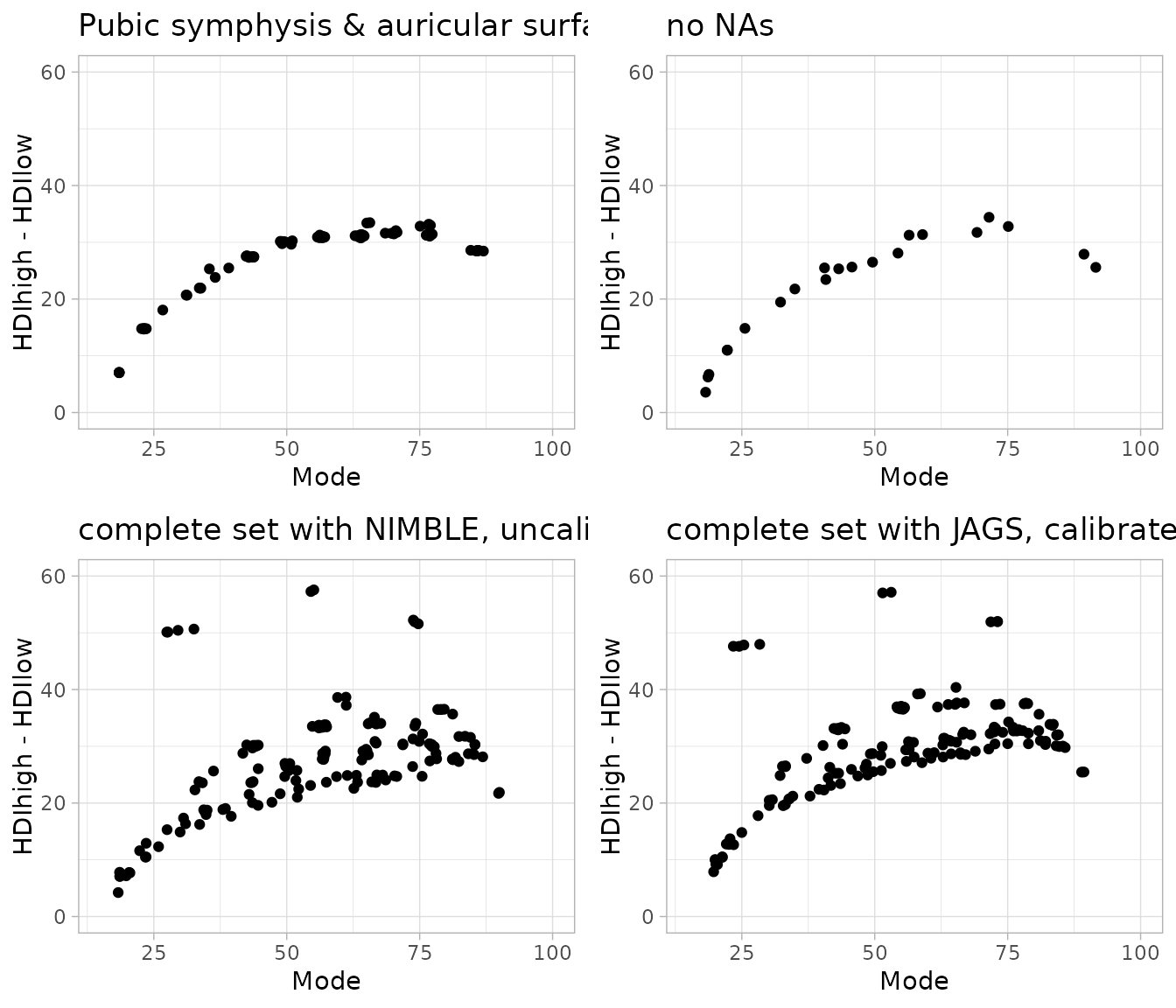
As noted previously (Müller-Scheeßel et al. 2026), the HDI ranges are lowest in early life and increase from there onwards. However, at about an age mode of 60–70 years, they start to shrink again.
The plots of the joined analysis of the auricular surface and the
pubic symphysis as well as that for the data set without
NAs look very similar, despite the fact that the first
model contained much more entries than the second. In both cases, the
point estimates form a rather clean arc. In contrast, the complete model
looks rather messy with some extreme outliers, presumably from
individuals were only the weakest method, dental wear, was assessable.
Furthermore, the clean arc of the first two models has disappeared
because middle-aged individuals were assessed overall younger than in
the first two models. In comparison, the complete model with the
calibration term of 5 years has again moved closer to the model without
NAs. This we would take as a hint that the estimates of the
model with calibration term are more conservative.
Next, we compare the calibrated estimated ages-at-death with the true ages-at-death known for 16 individuals.
chelsea_complete$estimated_age <-
  round(chelsea_complete_cal_diag_red_ages[,5],1)
chelsea_complete[,c("AGE", "known_age", "estimated_age")] |>
na.omit() |> knitr::kable()| AGE | known_age | estimated_age | |
|---|---|---|---|
| 5 | ADULT >46 YEARS | 60 | 58.9 |
| 16 | ADULT >46 YEARS | 67 | 75.2 |
| 24 | ADULT 36-45 YEARS | 44 | 56.5 |
| 62 | ADULT 36-45 YEARS | 61 | 58.6 |
| 76 | ADULT >46 YEARS | 70 | 78.1 |
| 93 | ADULT >46 YEARS | 84 | 71.8 |
| 100 | ADULT >46 YEARS | 66 | 62.8 |
| 103 | ADULT >46 YEARS | 84 | 80.8 |
| 105 | ADULT >46 YEARS | 78 | 85.8 |
| 107 | ADULT >46 YEARS | 68 | 78.8 |
| 109 | ADULT >46 YEARS | 56 | 66.7 |
| 114 | ADULT 36-45 YEARS | 70 | 48.4 |
| 122 | ADULT >46 YEARS | 68 | 66.5 |
| 143 | ADULT >46 YEARS | 54 | 56.2 |
| 144 | ADULT 26-35 YEARS | 32 | 32.6 |
| 161 | ADULT 36-45 YEARS | 70 | 55.6 |
The agreement between known and estimated age-at-death is already
very satisfying. Eye-balling shows only three more severe outliers (nos.
24, 114 and 161). The traditional aging method is wrong in three cases
(nos. 62, 114, 161). For a more systematic comparison, we evoke the
helper function age.comp.summary().
summary_list <- lapply(c("Mode", "Median", "Mean"), function(choice) {
  age.comp.summary(mcmc_list = chelsea_complete_cal_res,
                   known_age = chelsea_complete$known_age,
            age_identifier = "age.s_c",
                   mean_choice = choice)})
summary_mat <- do.call(rbind, summary_list)
rownames(summary_mat) <- c("Mode", "Median", "Mean")
summary_mat |> t() |> knitr::kable(digits = 2)| Mode | Median | Mean | |
|---|---|---|---|
| Bias | 0.09 | 0.44 | 0.52 |
| corrPearson | 0.74 | 0.75 | 0.74 |
| corr_p | 0.00 | 0.00 | 0.00 |
| Residual_slope | 0.25 | 0.25 | 0.27 |
| Inaccuracy | 7.52 | 7.31 | 7.30 |
| RMSE | 9.47 | 9.35 | 9.36 |
| TMNLP | 3.99 | 3.99 | 3.99 |
| CRPS | 5.26 | 5.26 | 5.26 |
Above the resulting coverage for 95% credibility was computed. As
already pointed out above, the first six frequentist quality measures
are dependent on the point estimate and therefore malleable to the
chosen measure of the mean. The mode is best in terms of the first four
quality measures while the arithmetic mean performs better for
Inaccuracy and RMSE. The median is somehow
in-between. The two Bayesian measures TMNLP and
CRPS, in contrast, do not change, regardless which point
estimate was chosen.
When reviewing the quality measures itself (see Müller-Scheeßel et al. 2026 for a short review of
some tests of age estimation methods), the performance is quite
good. Most single methods will not reach an Inaccuracy of
7.3 years or a CRPS of 5.25.
A formal test of the coverage is the binomial test which checks if the resulting numbers deviate significantly from expectation. Below, we do this for several credibility ranges. Due to the small sample size of only 16 age-known individuals, we cannot expect any significant result.
sequential.binom.test(chelsea_complete_cal_res,
                      HDImass = c(seq(0.5, 0.9, 0.1), 0.95),
                      age_identifier = "age.s_c",
                      known_age = chelsea_complete$known_age) |>
knitr::kable(digits = 3)| coverage | n_in | perc | CI_low | CI_up | p_value |
|---|---|---|---|---|---|
| 0.50 | 7 | 0.438 | 0.198 | 0.701 | 0.804 |
| 0.60 | 9 | 0.562 | 0.299 | 0.802 | 0.802 |
| 0.70 | 12 | 0.750 | 0.476 | 0.927 | 0.790 |
| 0.80 | 13 | 0.812 | 0.544 | 0.960 | 1.000 |
| 0.90 | 15 | 0.938 | 0.698 | 0.998 | 1.000 |
| 0.95 | 15 | 0.938 | 0.698 | 0.998 | 0.560 |
We show the relationship between known and estimated age-at-death
also in a series of plots which are generated with the helper function
age.comp.plot().
age.comp.plot(x = chelsea_complete_cal_diag,
            age_identifier = "age.s_c",
            known_age = chelsea_complete$known_age,
            mean_choice = "Mode")
#> Warning: Removed 25 rows containing missing values or values outside the scale range
#> (`geom_line()`).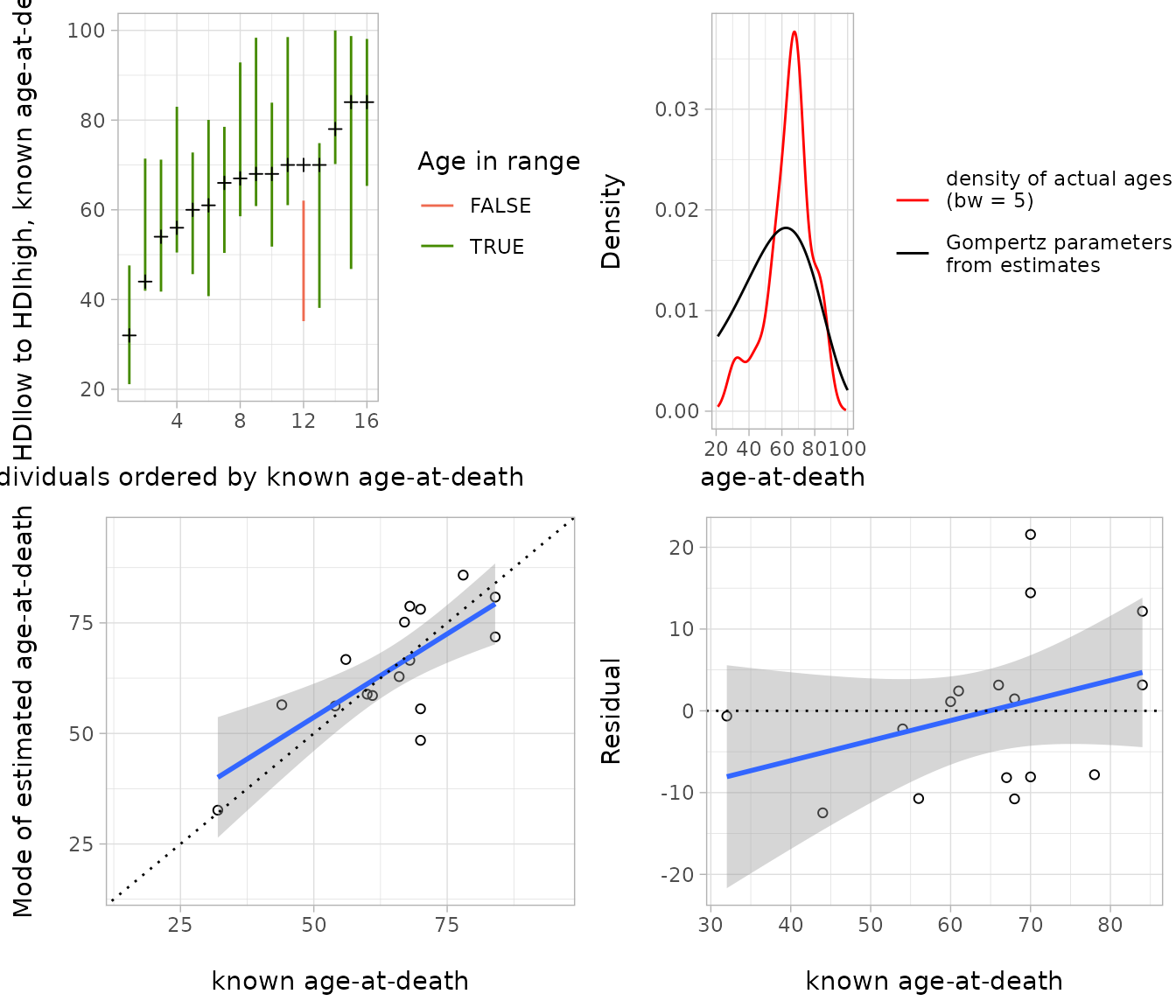
Only one HDI range does not include the true age (left
top). The top right plot shows the Gompertz function based on the
estimates of all individuals (in black) with the density of the known
ages-at-death (in red). That the latter represent a part of the
population seems from this plot at least not implausible. The two bottom
plots illustrate the differences of the point estimate from the known
age-at-death. Especially the right bottom plot also shows the systematic
deviation which leads to a residual slope of 0.21. Most
differences between estimated and known age are at about 10 years or
below but one case deviates by more than 20 year.
Conclusions
One of the main aims of the above workflow was to show how the
highest density intervals can be calibrated when several traits
are observed but the data is incomplete. This entails to run a
multivariate normal model with only those cases that do not contain any
NA values and then set the calibration in such a way that
the ensuing HDIs emulate that from the model with no
NAs. For the Chelsea ‘Old church’ data set, this had lead
to age ranges that fit to the known ages-at-death.
Apart from this, two further aspects which become apparent with the
Chelsea ‘Old church’ data set merit attention. The first concerns the
different mean and modal ages for the different model based on different
traits and trait combinations. It has to be kept in mind that the
ensuing samples are not identical and only partly overlap. That means
that the different mean ages might well reflect true differences in the
age composition of the respective samples. Especially in the case of the
model of no NAs, that is the one where all traits were
assessable, the low mean age is noteworthy, despite the fact that the
plot with the ages and the HDIs looked very similar to the
one with auricular surface and pubic symphsis. Therefore, we have to
consider that age-at-death and completeness of trait observations is
very probably not independent from one another. This suggests that
missingness is not random with respect to age, which may bias
multivariate estimates.
The second aspects relates to the highest density intervals:
For the multivariate normal models, these were around 30 years of age.
This is the same range which was found for the DRNNAGE system (Müller-Scheeßel et al. 2026) but also for the
new ABDOU transition analysis (manuscript in prep.). It seems quite
possible that with methods based on pathological changes in the
skeleton, as those age markers essentially are (Fuchs et al. 2026),
we cannot get below this threshold of 30 years. This seems to equal an
inaccuracy level of about 6–7 years or a CRPS of about 4–5
years.